About
Agent DVR uses motion detection or AI to generate alerts. To access and configure Alerts settings, edit a device and select Alerts in the menu.
Alerts initiate an "Alert" Action, allowing you to execute tasks like sending an email, sounding an alarm, calling a URL, etc., when Agent DVR raises Alerts.
Agent DVR can record video based on Alert or Motion Detection. To minimize unnecessary recordings, set the Recording Mode on the Recording tab to "Alert" and then configure how Agent DVR raises alerts using the settings below.
Agent DVR features a master switch for arming and disarming the system.
The top left icon displays a symbol when Agent DVR is armed and a symbol when Agent DVR is disarmed. Click the symbol to toggle between these states.
Tip: If you are using trip wires to trigger alerts and they are not being activated, ensure that the Alert Direction setting is not configured to "None".
Alert Settings
These settings control when a device raises an alert and how often alerts can repeat.
- Enabled: Toggle to enable or disable Alerts for a device.
- Mode: Choose from Detected, Not Detected, or Actions Only (v4.5.0.0+). Trigger an alert when motion is detected, or conversely, when no movement is detected (useful for monitoring machinery). Use Actions Only to trigger alerts exclusively via actions. See Alert Filtering for more details.
- Detection Delay: The time in seconds before an alert is triggered after detection.
- Not detected alert delay: The time in seconds before an alert is triggered if no motion is detected.
- Reset Mode: Choose how to manage alert resets (based on an interval or an idle timeout).
- Interval: The minimum time in seconds to use for the alert reset mode:
- Interval: If set to 60, alerts will be suppressed for 1 minute.
- Idle Timeout: If set to 60, alerts will be suppressed until 1 minute of inactivity has elapsed.
- Merge Delay: (advanced, v8.0.6+, seconds) Keep each alert open for this many seconds so later AI results merge into one alert. When a camera runs motion, object and face recognition together, each can trigger the alert and normally the first one wins (usually a distant "person") while the later, better result (a recognised face) is dropped by the interval. With a merge delay of, say, 10 seconds, everything that triggers inside that time is folded into a single alert: tags accumulate with recognised faces and plates first, then detected objects, then motion tags, and the stored image is the frame from the highest-ranked trigger (a recognised face beats an object detection beats motion). Recording still starts immediately; the notification, the stored alert and any actions on the Alert event wait until the delay has passed, so they are delayed by this long. The stored alert keeps the time of the first trigger, so it lines up with the recording. This works alongside the Interval above: the Interval decides whether a trigger is accepted at all, the Merge Delay decides how long an accepted alert collects further results before it is raised. Set the Merge Delay shorter than the Interval and about as long as one event takes, for example 10 seconds. 0 (the default) raises alerts immediately as before.
- Alert Group: Specify a group for raising alerts. Alerts in a group can trigger recording on all devices within that group. The group's interval setting overrides the device's minimum interval. Group Alert and Group Detect modes are available under the Recording tab.
- Messaging: Enable or disable messaging actions like Email or SMS (configured on the Actions tab). See our wizard for formatting your number
- Describe Alerts: Use AI to describe alert images - see Describe Alerts.
- Prompt: The prompt sent to the AI along with the alert images - see Describe Alerts.
- Video Previews: Generate a looping video preview of the recording when an alert is viewed - see Alert Display. Switch this off if you review large numbers of alerts quickly and just want the alert image on its own.
Describe Alerts
Describe Alerts uses AI to write a short description of what triggered an alert. Agent sends a few frames from the moment of the event to your AI provider and stores the reply with the alert. The description also appears in push notifications via the {AI} template tag, so instead of "Motion detected" your phone shows something like "A person is carrying a package to the front door".

- Describe Alerts: Check this to describe alert images. It uses the AI provider configured in Server Settings - AI; Ask AI does not need to be enabled on the camera. If no provider is configured Agent shows a warning with a button that opens the Gemini setup dialog - Gemini has a free usage tier that covers typical use and the dialog links to where you can get a free API key.
- Prompt: The prompt sent to the AI with the images. The default asks for a KEYWORDS line (used to tag the alert - see Reply keywords below) followed by a one sentence description of the activity, focused on people, vehicles and animals, with a brief note when it looks like a false trigger (insects, rain, shadows). You can have some fun with this though, for example "Describe what is happening in pirate speak".
- AI Frames (Advanced): How many frames to send with each request (1 to 8, default 3). Agent samples frames a second apart ending at the moment of the alert, so more frames show the AI more of the event. Fewer frames are cheaper on paid API keys and faster on local AI servers. Note that on free tiers the daily request limit counts requests, not frames - lowering this does not make the daily cap go further. If the provider rate limits your API key, Agent logs a warning and shows a notice in the camera editor.
Reply keywords
You can tell the AI to reply with a keyword and Agent will act on it. Keywords are matched at the start of the reply, case insensitive. The description is always stored with the alert in the UI so you can see what the AI decided.
- KEYWORDS: - a first line like "KEYWORDS: person, package" is stripped from the description and added to the alert's tags. Recognized words: person, vehicle, animal, package, fire, smoke, nothing (anything else is ignored). Tagged alerts work with tag filtering and search just like object detection tags. The default prompt asks for this.
- unimportant - the description is left out of the push notification text. The alert and notification still fire.
Describe never suppresses alerts or notifications - it only annotates them. To have AI decide whether an alert fires at all (for example, only alert when a person is present), set the alert Mode to AI Trigger and use the Look for field on the AI tab. Combined with recording on detect, that gives you "record all motion but only alert on real activity".
Example prompts
- Security (default):
On the first line reply with KEYWORDS: followed by any of these that apply: person, vehicle, animal, package, fire, smoke, nothing. On the next line, in one short sentence, describe the activity for a security notification, focusing on any people, vehicles or animals. If it looks like a false trigger (an insect, rain, headlights or shadows) just say so briefly. - Quiet notifications:
In one short sentence describe any people, vehicles or animals. If nothing important is happening reply with just the word unimportant. - Deliveries:
In one short sentence describe any deliveries or people approaching the door. If nothing is being delivered and no one is approaching reply with just the word unimportant. - Pets:
In one short sentence describe what any animals in view are doing. - Fun:
Describe what is happening in pirate speak.
Once alerts are being described you can integrate the results with the Actions system using the AI: Describe Response Received event. You can use {MESSAGE} and {AIJSON} in tasks from this action for other integrations.
Push Alerts
Push alerts can push real-time notifications to your mobile devices (iOS/ Android) via our mobile applications. See mobile push alerts
- On: Switch on or off Push Alerts.
- Alert Template: The text of the notification. You can use tags like {NAME} and {TAGS} here. {AI} adds the Describe Alerts description, so notifications read like "Person carrying a package at the front door".
- Push Video: Generate and push a short video notification (iOS/ Telegram only).
- Include Audio: Include audio in the generated clip (iOS/ Telegram only).
Note: Push alerts use our web services so are subscription only.
Alert Filtering
See Alert Filtering
Manual Alerts
You have the option to trigger alerts manually for individual devices. To initiate a manual alert, go to the Live view, select the desired device, and then click on the icon located at the bottom left of the screen.
These manual alerts will activate recordings if the device's recording mode is set to Alert. To associate actions with a manual alert, you should use the "Manual Alert" event rather than the standard "Alert" event.
Alerts Summary
As Agent DVR generates alerts, or as you trigger manual alerts, you'll see a counter increase at the top right of the Agent DVR UI. This is the system alert counter. Clicking on it displays a summary of alert events:
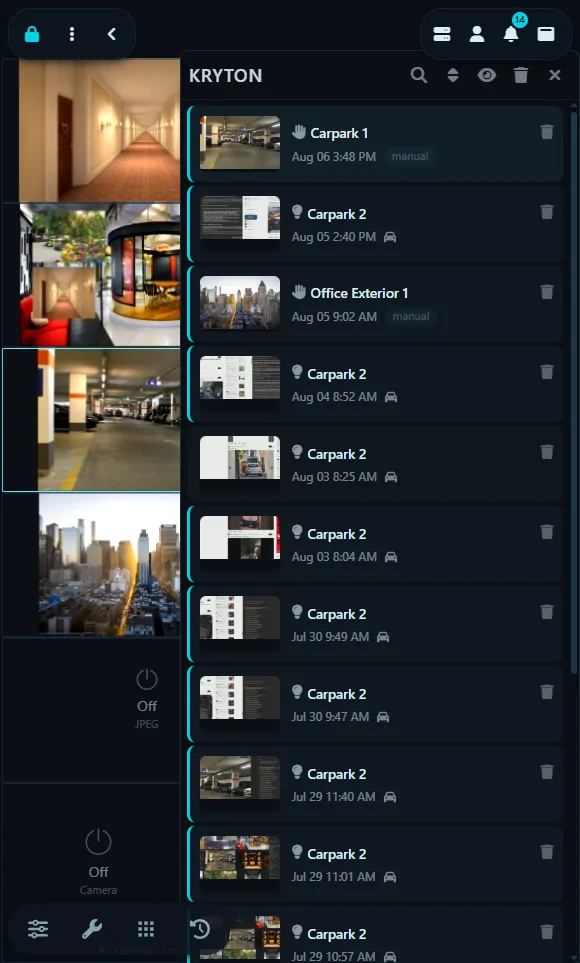
Agent DVR generates thumbnails for each event when possible. Clicking a thumbnail opens the alert display with the image and video from the event. To acknowledge an alert, click on its text. This action switches the view to the timeline, providing context for the event with any other system recordings. The timeline will automatically navigate to just before the event occurred. If a recording is available, you can click on it in the Agent DVR UI, and playback will start from the point the alert was generated.
To delete alerts, use the bin icon to clear all alerts or remove them individually. Close the alerts panel by clicking the icon button in the top bar.
Alert panel icons indicate the alert type: manual alerts are marked with , alerts generated by Agent DVR with , AI-generated alerts with , and alerts suppressed by feedback with .
Alert Display
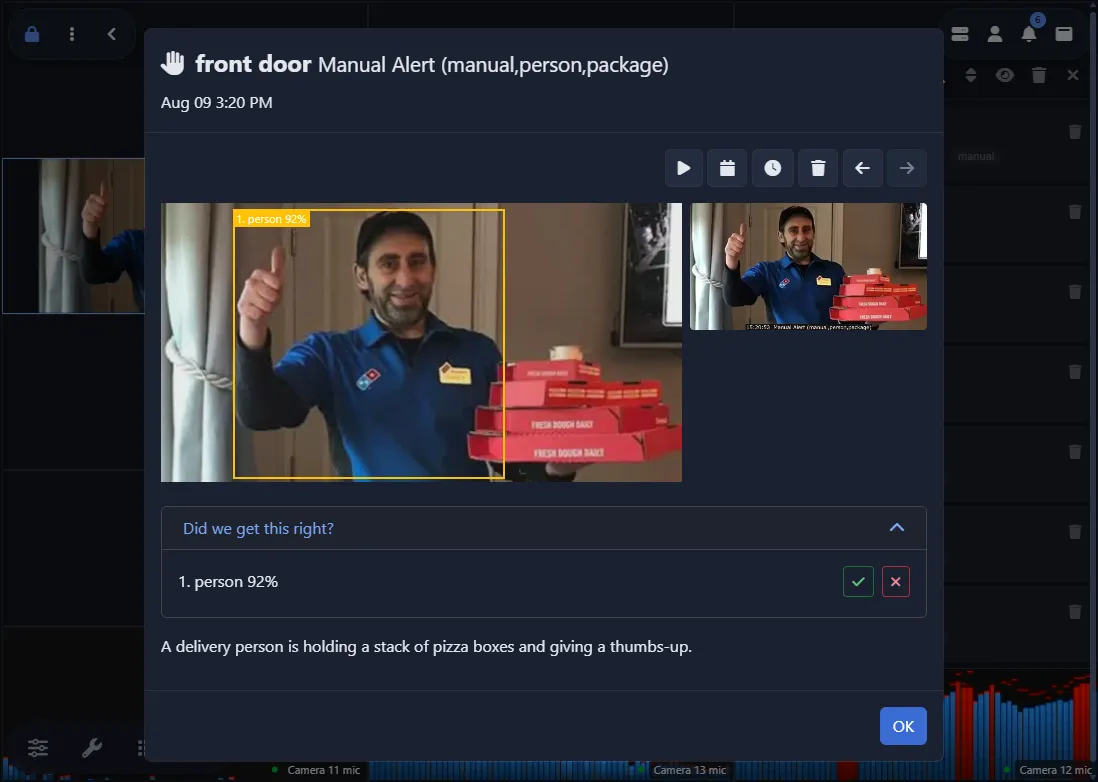
Clicking an alert thumbnail opens the alert display, which brings together everything Agent knows about the event: the alert image, an animated video preview of the recording, the detection feedback panel and the AI description.
Video preview
For camera alerts Agent generates a short looping video preview from the recording that covers the alert, so you can see what happened without leaving the panel. Previews are created on demand when you open the alert - nothing is generated in the background. The alert opens with the image shown full width; when the preview is ready an inset tile appears and the preview swaps into the large position (the alert image keeps the large spot if the feedback panel is open, since the numbered detection boxes are drawn on it).
- Click the smaller tile to swap which media is shown large.
- Click the preview while it's large to open the recording for full playback.
- A REC badge means the camera is still recording the event - the preview covers the recording so far, and reopening the alert later fetches the complete version.
- If no recording covers the alert time (for example, recording is off), or the camera's Video Previews setting is off (see Alert Settings), the preview never appears and the alert image is simply shown on its own.
Detections and feedback
Alerts raised by Object Recognition store their detections with the alert. On cameras with Learn From Feedback enabled, expanding the collapsible "Did we get this right?" panel draws each detection as a numbered box on the alert image with its label and confidence, and lists it with and buttons - confirming or rejecting detections teaches Agent to suppress similar false alerts on that camera, and everything is learned locally. See Learning From Feedback for how the learning and suppressed alerts work.
To show detection boxes on alert images without the learning feature, enable the Overlay in the camera's Object Recognition settings - the boxes are then drawn into the alert image (and live video) itself.
AI description
If Describe Alerts is enabled, the AI's description of the event is shown below the feedback panel - the same text that appears in push notifications via the {AI} tag.
The toolbar buttons above the image play the recording, jump to the event on the Timeline or Time Machine, delete the alert and step to the previous or next alert.